
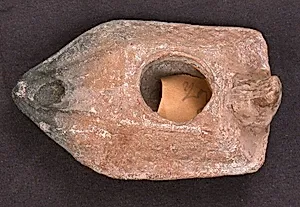
Lamp
Unknown Artist
7th–11th century
Medium
Earthenware; unglazed
Dimensions
H. 1 7/8 in. (4.8 cm) W. 2 3/8 in. (6 cm)
Classification
Ceramics
Department
Islamic Art
Museum
Metropolitan Museum of Art, New York, NY
Credit
Gift of Miriam Schaar Schloessinger, 1964
Accession Number
64.207.1
Rights
Public Domain
Art Historical Context
This modest earthenware lamp, dating from the 7th to 11th century, offers a glimpse into the everyday life of the early Islamic world. Crafted unglazed clay and standing just 1 7/8 inches high and 2 3/8 inches wide, it the simple, functional ceramics produced during the formative centuries of Islam, from the Umayyad early Abbasid periods. These small oil lamps, likely hand-formed on a wheel or by molding, were ubiquitous in homes, mosques, markets across regions like the Levant, Mesopotamia, and North Africa, illuminating spaces before modern electricity. Unglazed earthenware was a practical choice for such utilitarian objects, fired at low temperatures to create a durable, porous surface ideal for holding olive oil and a wick. While later Islamic ceramics dazzled with intricate glazes and motifs, this lamp reflects an earlier, unadorned aesthetic prioritizing utility over ornamentation—a testament to the resourcefulness of artisans in a burgeoning civilization. Its survival highlights the resilience of everyday artifacts in archaeological records. Today, this lamp graces the Metropolitan Museum of Art's Islamic Art Department, a gift from Miriam Schaar Schloessinger in 1964. It invites us to ponder the quiet glow it once cast on family gatherings, prayers, and stories, bridging ancient traditions with our modern curiosity.