
Lance Point
Unknown Artist
15th century
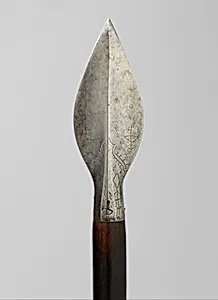
Dimensions
L. 5 3/4 in. (14.6 cm); W. 2 in. (5.1 cm); L. of blade 4 1/2 in. (11.4 cm); Wt. 4 oz. (113.4 g)
Classification
Shafted Weapons
Culture
Spanish
Department
Arms and Armor
Museum
Metropolitan Museum of Art, New York, NY
Credit
Gift of William H. Riggs, 1913
Accession Number
14.25.482
Rights
Public Domain
Art Historical Context
Step into the riveting world of 15th Spanish warfare with this finely crafted *Lance Point*, a testament to medieval arms technology. Measuring just 5¾ inches long with a 4½-inch blade, this lightweight (4 oz.) spearhead was designed for mounting on a wooden shaft, forming a lance ideal for cavalry charges or knightly jousts. Produced in Spain during a turbulent era of the Reconquista—when Christian kingdoms battled Muslim forces in the Iberian Peninsula—this weapon exemplifies the era's demand for precise, lethal tools that balanced speed and penetration. Though the artist remains unknown, the lance point's compact dimensions and robust form highlight advanced blacksmithing techniques, likely involving forging and tempering of iron or steel for durability on the battlefield. Spanish armorers were renowned for such innovations, contributing to the prowess of Iberian knights in tournaments and crusades. Its survival offers a glimpse into the gritty reality of combat, where a well-made point could turn the tide of battle. Today, this artifact graces the Metropolitan Museum of Art's Arms and Armor Department, a gift from collector William H. Riggs in 1913. It invites us to ponder the blend of artistry and aggression that defined chivalric Europe.