
Lancelot Andrewes, Bishop of Winchester
1632
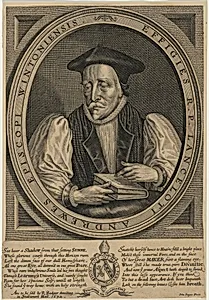
Medium
engraving
Dimensions
plate: 22.8 × 16 cm (9 × 6 5/16 in.)
Classification
Department
CG-E
Museum
National Gallery of Art, Washington, D.C.
Credit
Rosenwald Collection
Accession Number
1950.14.26
Rights
Public Domain
Art Historical Context
Behold the striking 1632 engraving *Lancelot Andrewes Bishop of Winchester* by John Payne, a example of 17th-century British printmaking. Captured in precise detail on a modest plate measuring 22.8 × 16 cm, this portrait from the National Gallery of Art's Rosenwald Collectionizes the revered Anglican bishop, who served as Bishop of Winchester until his death in 162. Payne, a skilled engraver of his era, employs the intaglio technique—incising fine lines into a metal plate to hold ink—creating rich contrasts and textures that bring Andrewes's dignified likeness to life. Engravings like this were revolutionary for their time, allowing high-quality images to be reproduced and disseminated widely across England and beyond, far more affordably than paintings. This medium democratized portraiture, honoring influential churchmen like Andrewes, a key figure in the Church of England during the Jacobean and Caroline periods. His stern gaze and ecclesiastical robes evoke the era's religious fervor and intellectual rigor. Displayed in the CG-E department among distinguished prints, this work offers visitors a window into early modern portrait traditions, blending technical mastery with cultural reverence. A testament to Payne's craft, it reminds us how prints preserved the legacies of the mighty.
About the Artist
John Payne · 1600–1640
John Payne is an artist whose biographical details remain difficult to establish with certainty, partly because the name is common and several artists of that name were active in different periods and countries. The works attributed to this John Payne suggest engagement with printmaking or illustration traditions, but without confirmed dates, nationality, or documented training, a precise account ...