
Landscape
1825–64
Medium
Graphite
Dimensions
11 7/16 x 16 3/16 in. (29.1 x 41.1 cm)
Classification
Drawings
Department
Drawings and Prints
Museum
Metropolitan Museum of Art, New York, NY
Credit
Rogers Fund
Accession Number
1970.114.3
Rights
Public Domain
Tags
Art Historical Context
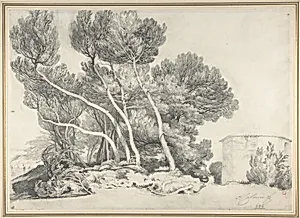
In the tranquil *Landscape* by Swiss artist Alexandre Calame (1810–1864), visitors encounter a masterful graphite drawing that captures the essence of 19th-century Romanticism Created sometime between 1825 and 1864 during the height of Calame's career this 11 7/16 x 16 3/16-inch sheet (29.1 x 41.1 cm) his lifelong passion for depicting nature's grandeur, particularly the majestic Swiss Alps and forested scenes. Acquired through the Rogers Fund and housed in the Metropolitan Museum of Art's Department of Drawings and Prints, it invites contemplation of the artist's precise observation of trees and rolling terrain. Calame, often called the "painter of the Alps," bridged Neoclassicism and Romanticism with his meticulous, atmospheric landscapes that evoked awe and the sublime power of the natural world. Graphite, a humble yet versatile medium, allowed him to achieve delicate tonal gradations and intricate details—techniques honed in sketches that often served as studies for his grand oil paintings. These drawings highlight his innovative use of light and shadow to convey depth and mood, influencing later landscapists like the Hudson River School. This understated work underscores the cultural importance of preparatory drawings in the Romantic era, where capturing fleeting natural beauty on paper preserved the era's reverence for wilderness amid rapid industrialization. A gem for drawing enthusiasts, it reminds us that true artistry lies in simplicity and sensitivity to the land.
About the Artist
Alexandre Calame · 1810–1864
Comment on works: Landscapes