
Landscape
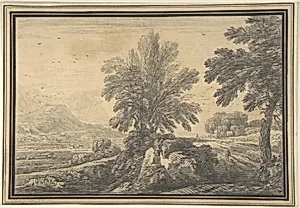
Medium
Graphite; framing lines in pen and black and brown ink
Dimensions
8 7/16 x 12 5/16in. (21.5 x 31.2cm)
Classification
Drawings
Department
Drawings and Prints
Museum
Metropolitan Museum of Art, New York, NY
Credit
The Elisha Whittelsey Collection, The Elisha Whittelsey Fund, 1953
Accession Number
53.519.52
Rights
Public Domain
Tags
Art Historical Context
Jean-Baptiste-Claude Chatelain's *Landscape*, created between 1730 and 1758, captures the serene beauty of nature through delicate graphite lines accented by framing in pen and black and brown ink. This 18th-century French drawing, measuring 8 7/16 x 12 5/16 inches, exemplifies the Rococo era's fascination with idyllic pastoral scenes, where artists like Chatelain—known for his topographic views and etchings—inspired by masters such as Claude Lorrain, evoked harmonious landscapes teeming with mountains, trees, and expansive vistas. The use of graphite allowed for subtle shading and texture, mimicking the soft light and atmospheric depth prized in Rococo draftsmanship, while the ink framing lines add a precise, etched quality hinting at potential print reproductions. Chatelain, who worked in both France and England, often produced such studies for patrons seeking elegant depictions of the natural world amid the Enlightenment's growing appreciation for topography and travel sketches. Housed in the Metropolitan Museum of Art's Drawings and Prints department as part of The Elisha Whittelsey Collection (acquired via the Elisha Whittelsey Fund in 1953), this work highlights the technical virtuosity of preparatory drawings, bridging painting and printmaking in an age when landscapes symbolized escape and sublime beauty. Visitors will appreciate its intimate scale and timeless tranquility.