
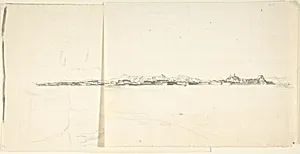
Landscape
19th century
Medium
Pencil and two sheets of wove paper pasted together. Squared.
Dimensions
6 5/16 x 12 1/2 in. (16 x 31.7 cm)
Classification
Drawings
Department
Drawings and Prints
Museum
Metropolitan Museum of Art, New York, NY
Credit
Harris Brisbane Dick Fund, 1953
Accession Number
53.600.3627
Rights
Public Domain
Tags
Art Historical Context
Franz von Hauslab the Younger's *Landscape*, created in the 19th century, captures the serene beauty of a mountainous scene dotted with houses. This intimate drawing, executed in pencil on two sheets of wove paper meticulously pasted together, measures just 6 5/16 x 12 1/2 inches. The squared grid overlay—a practical technique used by artists to scale up sketches for larger paintings or engravings—hints at its role as a preparatory study, blending precision with natural observation. Hauslab, working in an era when Romanticism celebrated the sublime power of nature, employs fine pencil lines to evoke the rugged contours of mountains and humble village structures. Wove paper, prized for its smooth texture, allowed for delicate shading and detail, making it ideal for detailed landscapes like this. Such drawings were often personal tools for artists exploring topography and light outdoors. Now part of the Metropolitan Museum of Art's Drawings and Prints collection, thanks to the Harris Brisbane Dick Fund of 1953, this work offers a window into 19th-century draftsmanship. It reminds us how simple materials could immortalize everyday vistas, bridging the artist's hand with the enduring allure of the Alps-like terrain.