
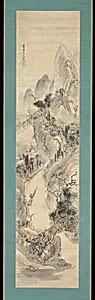
Landscape
18th–19th century
Medium
Hanging scroll; ink and color on satin
Dimensions
Image: 58 7/16 x 13 1/4 in. (148.4 x 33.7 cm) Overall: 82 1/2 x 20 3/4in. (209.6 x 52.7cm)
Classification
Paintings
Culture & Period
Japan · Edo period (1615–1868)
Department
Asian Art
Museum
Metropolitan Museum of Art, New York, NY
Credit
The Harry G. C. Packard Collection of Asian Art, Gift of Harry G. C. Packard, and Purchase, Fletcher, Rogers, Harris Brisbane Dick, and Louis V. Bell Funds, Joseph Pulitzer Bequest, and The Annenberg Fund Inc. Gift, 1975
Accession Number
1975.268.100
Rights
Public Domain
Tags
Art Historical Context
This hanging scroll, titled *Landscape*, was created by the Japanese artist Kushiro Unsen during the Edo period (1615–1868). time of relative peace and refinement in Japan, the era saw a flourishing of painting traditions that often drew on both native aesthetics and influences from Chinese literati art. Unsen’s work exemplifies this blend, using delicate ink washes and subtle color on satin to evoke serene natural scenery. Hanging scrolls like this one were designed for intimate viewing in Japanese homes or temples, where they could be unrolled for display and then stored away. The tall, narrow format encourages the eye to travel gradually through the composition, mirroring the contemplative experience of walking through a landscape. Satin as a support adds a luminous quality to the ink and pigments, enhancing the sense of depth and atmosphere. As part of the Metropolitan Museum’s Asian Art collection, this piece reflects the enduring importance of nature in Japanese artistic expression. Landscapes served not merely as depictions of scenery but as invitations to reflect on harmony, transience, and the beauty of the natural world.