
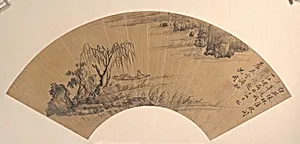
明/清 佚名 倣沈周 山水 扇|Landscape
16th century or later
Medium
Folding fan mounted as an album leaf; ink on gold paper
Dimensions
6 7/8 x 20 3/4 in. (17.5 x 52.7 cm)
Classification
Paintings
Culture & Period
China · Ming (1368–1644) or Qing (1644–1911) dynasty
Department
Asian Art
Museum
Metropolitan Museum of Art, New York, NY
Credit
John Stewart Kennedy Fund, 1913
Accession Number
13.100.73
Rights
Public Domain
Tags
Art Historical Context
This delicate landscape painting, titled *Landscape* (山水扇), is the work of an unidentified Ming or Qing dynasty artist emulating the style of Shen Zhou (1427–1509), the revered founder of the Wu school of literati painting. Dating to the 16th or later, it captures essence of Ming (1368–1644) or Qing (16441911) artistic traditions where imitation of masters like Shen Zhou a form of homage and scholarly practice. Shen Zhou's is evident in the loose, expressive brushwork that prioritizes poetic harmony over realism, reflecting the literati ideal of blending art, nature, and personal cultivation. Originally a folding fan, now elegantly mounted as an album leaf, the piece measures 6 7/8 x 20 3/4 inches and is rendered in ink on shimmering gold paper—a luxurious ground that enhances the misty mountains, winding rivers, and tranquil boats. Fans were prized possessions among China's educated elite, serving as portable canvases for spontaneous creation, social exchange, or quiet contemplation during gatherings. This intimate format underscores the shan shui (mountains-and-waters) genre's cultural role in evoking transcendence and the sublime beauty of the natural world. Acquired in 1913 via the John Stewart Kennedy Fund, this artwork at the Metropolitan Museum of Art exemplifies how later artists perpetuated Ming masters' legacies, bridging dynasties in China's enduring landscape tradition.
About the Artist
Shen Zhou|Unidentified artist · 1427–1509
Chinese, 1427–1509