
Landscape
Medium
Etching
Dimensions
Sheet (trimmed): 2 13/16 × 4 1/2 in. (7.1 × 11.5 cm)
Classification
Prints
Department
Drawings and Prints
Museum
Metropolitan Museum of Art, New York, NY
Credit
The Elisha Whittelsey Collection, The Elisha Whittelsey Fund, 1960
Accession Number
60.622.4(3)
Rights
Public Domain
Tags
Art Historical Context
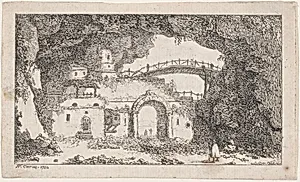
Pierre Nicholas Camus’s *Landscape* (1780) captures a quiet, intimate view of rural buildings nestled within a natural setting. Created as an etching on a modestly sized sheet measuring just over 4½ inches wide, the work reflects the 18th-century interest in picturesque scenery that appealed to both collectors and travelers of the period. Camus, working in France during the final decades before the Revolution, used the etching medium to translate delicate lines and tonal contrasts into reproducible images that brought the countryside into private homes and print cabinets. Etching allowed artists like Camus to achieve fine detail and atmospheric effects with relative speed, making landscape prints widely accessible. The trimmed sheet and small scale suggest this impression was designed for inclusion in albums or portfolios, where viewers could appreciate the subtle interplay of architecture and nature at close range. Acquired by the Metropolitan Museum through the Elisha Whittelsey Fund, the print preserves a modest yet evocative moment of 18th-century printmaking.