
Landscape
1890
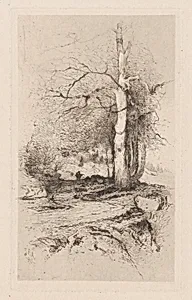
Medium
Drypoint
Dimensions
Sheet: 8 3/16 × 6 1/4 in. (20.8 × 15.9 cm) Plate: 5 1/4 × 3 1/8 in. (13.3 × 8 cm)
Classification
Prints
Department
Drawings and Prints
Museum
Metropolitan Museum of Art, New York, NY
Credit
Gift of Gilbert H. Anderson, 1910
Accession Number
10.1.2
Rights
Public Domain
Tags
Art Historical Context
Frank Anderson’s 1890 drypoint *Landscape* offers a quiet, intimate view of nature rendered in delicate lines and soft tonal effects. Created at a time when printmaking flourished in the United States, the work exemplifies the late-nineteenth-century interest in capturing atmospheric scenes through accessible, reproducible media. Its modest plate size—just over five by three inches—invites close looking, rewarding viewers with the subtle textures that emerge from the inked surface. Drypoint, the technique employed here, involves drawing directly into a metal plate with a sharp needle. The raised burr of metal that forms along each line holds ink, producing the velvety, slightly blurred quality characteristic of the medium. Anderson used this method to evoke the gentle gradations of foliage and sky, demonstrating how a simple landscape could convey both observation and mood without elaborate color or large scale. Acquired by the Metropolitan Museum of Art in 1910 as a gift from Gilbert H. Anderson, the print entered the collection during a period of active expansion in the Department of Drawings and Prints. Today it stands as a modest yet eloquent example of American landscape printmaking, illustrating how artists of the era translated the natural world into enduring works on paper.