
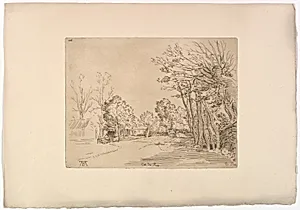
Landscape after Dürer
Medium
Etching
Dimensions
sheet: 12 1/16 x 17 3/16 in. (30.6 x 43.7 cm) plate: 7 11/16 x 10 3/16 in. (19.5 x 25.8 cm)
Classification
Prints
Department
Drawings and Prints
Museum
Metropolitan Museum of Art, New York, NY
Credit
Gift of Georgiana W. Sargent, in memory of John Osborne Sargent, 1924
Accession Number
24.63.1787
Rights
Public Domain
Tags
Art Historical Context
This etching, *Landscape after Dürer pays homage to the Renaissance master Albrecht Dürer through the skilled hand of Anne Claude Philippe deières, comte de Cay, an 18th-century French antiqu and engraver. Caylus meticulously reproduced Dürer's original landscape composition, capturing a serene vista of houses nestled among trees—a nod to Dürer's innovative Northern Renaissance style, which blended meticulous detail with natural observation. Though undated, it reflects the Enlightenment-era fascination with reviving classical and early modern masters, allowing Caylus to bridge 16th-century precision with 18th-century etching finesse. Etching, the medium here, involves coating a metal plate with acid-resistant ground, scratching designs into it, and immersing it in acid to etch lines of varying depth for rich tonal effects. The modest plate size (7 11/16 x 10 3/16 in.) yields intimate prints ideal for collectors, while the larger sheet preserves margins for framing. Housed in the Metropolitan Museum of Art's Drawings and Prints department, this work—gifted in 1924—highlights how reproductions preserved Dürer's legacy, influencing generations of landscape artists with their harmonious blend of architecture and nature. A delightful window into artistic lineage!
About the Artist
Albrecht Dürer|Anne Claude Philippe de Tubières, comte de Caylus · 1471–1528
Albrecht Dürer (1471–1528) stands as the preeminent figure of the Northern Renaissance and arguably the most influential artist in the history of printmaking. Born in Nuremberg on May 21, 1471, and dying in the same city on April 6, 1528, Dürer revolutionized the status of the artist in Northern Europe, transforming printmaking from a commercial craft into an independent fine art and establishing ...