
Landscape on the Oise
Medium
oil on panel
Dimensions
5.2; 35; 58.5
Rights
Public Domain
About this artwork
depth 5.2 cm
Art Historical Context
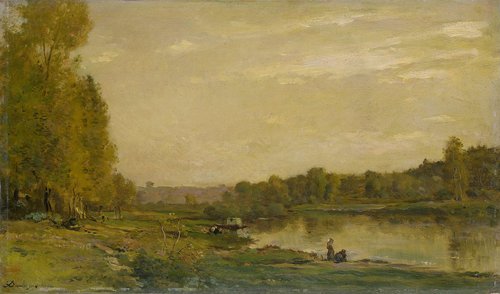
Charles-François Daubigny’s *Landscape on the Oise (1872) captures the serene beauty of the Oise River in northern France, a region the artist knew intimately. A leading figure in the Barbizon School Daubigny pioneered plein-air painting, working directly from nature rather than in the studio. This oil on panel, measuring 35 x 58.5 cm (with a depth of 5.2 cm), reflects his lifelong fascination with the Oise’s tranquil waterways, where he often painted from a custom-built studio boat. Daubigny’s loose, fluid brushwork emphasizes atmospheric effects—shimmering light on water, soft foliage, and expansive skies—bridging Realism and the emerging Impressionism. His innovative approach influenced younger artists like Claude Monet and Vincent van Gogh, who admired his fresh, unpolished naturalism. Created late in his career, this modest panel exemplifies his mastery of evoking mood through subtle color harmonies and dynamic compositions. Housed in Amsterdam’s Rijksmuseum, the work highlights Daubigny’s international appeal. Visitors can appreciate how this intimate scene distills the 19th-century shift toward celebrating everyday landscapes, inviting us to pause and immerse in nature’s quiet poetry.
About the Artist
Charles-François Daubigny · 1817–1878
Charles-François Daubigny was born on February 15, 1817, in Paris into a family of artists, with his father, Edmé-François Daubigny, a classical landscape painter, and his uncle, Pierre Daubigny, a miniaturist, providing his initial artistic training. He further studied under Jean-Victor Bertin, Jacques Raymond Brascassat, and Paul Delaroche at the École des Beaux-Arts, though he quickly moved bey...