
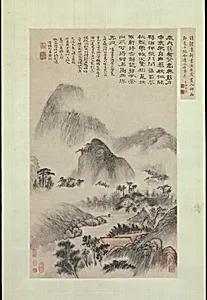
清 石濤(朱若極) 重陽山水圖 軸|Landscape Painted on the Double Ninth Festival
dated 1705
Medium
Hanging scroll; ink and color on paper
Dimensions
Image: 28 3/16 x 16 5/8 in. (71.6 x 42.2 cm) Overall with mounting: 86 1/8 x 23 in. (218.8 x 58.4 cm) Overall with knobs: 86 1/8 x 26 3/4 in. (218.8 x 67.9 cm)
Classification
Paintings
Culture & Period
China · Qing dynasty (1644–1911)
Department
Asian Art
Museum
Metropolitan Museum of Art, New York, NY
Credit
Ex coll.: C. C. Wang Family, Edward Elliott Family Collection, Purchase, The Dillon Fund Gift, 1981
Accession Number
1981.285.13
Rights
Public Domain
Tags
Art Historical Context
**Landscape Painted on the Double Ninth** by Shitao (Zhu Ruoji), dated 1705, captures the essence of Qing dynasty (1644–1911) literati painting in a masterful hanging scroll of ink and color on paper Measuring 28 3/16 x 16 5/8 inches, this intimate yet evocative landscape unfolds across misty mountains and winding rivers, inviting viewers into a serene, timeless world. Shitao, one of the "Four Great Monks" of Chinese painting and a Daoist innovator, created this work late in his life (1642–1707), blending orthodox traditions with his signature bold, expressive brushstrokes. The title nods to the Double Ninth Festival (Chongyang), a traditional Chinese holiday on the ninth day of the ninth lunar month, celebrated with chrysanthemum viewing, hill climbing, and themes of longevity and warding off misfortune. Shitao's composition likely evokes these auspicious motifs through layered peaks and atmospheric depth, showcasing his revolutionary "one-stroke" theory—unifying forms with fluid, spontaneous lines that prioritize personal expression over rigid formulas. As a transitional figure from Ming to Qing, his art challenged academic norms, influencing generations of individualist painters. Housed in the Metropolitan Museum of Art's Asian Art department from the C. C. Wang and Edward Elliott Family Collections, this scroll exemplifies the hanging format's role in private scholarly appreciation, unrolled for seasonal reflection. A gem of Chinese landscape tradition, it reminds us of art's power to harmonize nature, festival, and the artist's inner vision.