
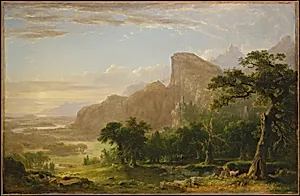
Landscape—Scene from "Thanatopsis"
Asher Brown Durand, 1850
About this artwork
Asher B. Durand's *Landscape—Scene from "Thanatopsis"* (1850), an oil-on-canvas masterpiece measuring nearly 40 by 61 inches, inspiration from William Cullen Bryant's poem *Thanatopsis*, a meditation on mortality amid nature's eternal cycles. Painted during the golden age of American landscape art, it captures a sweeping vista with mountains, a funeral procession, a farmer at work, and ruins evoking Egyptian, classical, and medieval civilizations—symbolizing death's universality across time and cultures. This monumental work, now in The Met's American Wing thanks to J. Pierpont Morgan's 1911 gift, invites viewers to contemplate life's impermanence within nature's grandeur. A leader of the Hudson River School's second generation, Durand evolved from engraver to master landscapist, blending meticulous naturalism with philosophical depth. His oil technique shines in botanical details, atmospheric effects, and harmonious composition, celebrating America's wild beauty as a source of moral and spiritual guidance for a modernizing nation. First shown at the National Academy of Design, the painting was popularized via the American Art-Union's lottery, bringing such profound art to middle-class homes. This piece exemplifies how 19th-century artists like Durand used landscapes not just for beauty, but as profound reflections on human existence, bridging poetry, nature, and national identity.