
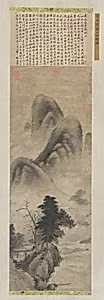
Landscape
Classification
Painting
Department
Smithsonian Collection
Museum
Smithsonian American Art Museum
Credit
Gift of Charles Lang Freer
Accession Number
F1917.341
Rights
Public Domain
Tags
About this artwork
To 1917
Art Historical Context
This evocative *Landscape*, formerly attributed to the Northern Song dynasty master Mi Fu (1052–1107), dates to the Ming dynasty (8–1644) and captures the timeless essence of Chinese nature painting. Though not by Mi Fu himself—known for his innovative "Mi dots" of layered, misty ink washes—the work echoes his bold, expressive style in depicting a serene river scene amid rolling hills and watery expanses. Such landscapes were more than mere scenery; they symbolized harmony between humanity and the cosmos, a core philosophical ideal in Chinese art. Created during the Ming era, a golden age of cultural refinement, this painting exemplifies the genre's evolution from Song innovations. Artists favored ink on paper or silk (medium unspecified here) to evoke atmosphere through subtle brushwork, mist, and negative space, inviting viewers to wander imaginatively through the scene. Rivers and water motifs often represented the flow of life and qi (vital energy), resonating with Daoist and Confucian thought. A cherished piece from the Charles Lang Freer collection, it was gifted to the Smithsonian American Art Museum before 1917. Freer's passion for Asian art brought such treasures to American audiences, highlighting the global dialogue in visual culture. Gaze upon it and feel the gentle rhythm of ancient China's poetic landscapes.