
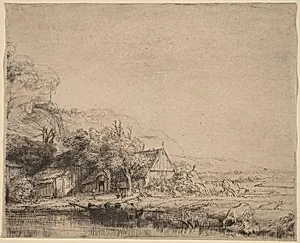
Landscape with a Cow
c. 1650
Medium
etching and drypoint
Classification
Department
CG-E
Museum
National Gallery of Art, Washington, D.C.
Credit
Rosenwald Collection
Accession Number
1943.3.7225
Rights
Public Domain
Art Historical Context
In the serene "Landscape with a Cow," around 1650 by the masterful Dutch artist Rembrandt van Rijn, encounter a tranquil pastoral scene etched with exquisite sensitivity. During the Dutch Golden Age, when prosperity fueled a fascination with the everyday beauty of the countryside, Rembrandt turned his genius to printmaking. This work captures a lone cow grazing amid rolling hills and distant trees, evoking the quiet harmony of rural life in 17th-century Netherlands. Rembrandt's use of etching and drypoint techniques shines here. Etching allowed precise, fluid lines incised into a copper plate with acid, while drypoint added velvety burrs from direct needle scratches, producing rich tonal depths and luminous effects. These methods, perfected by Rembrandt, elevated printmaking from mere reproduction to a painterly art form, rivaling his oils in emotional depth and light play. Housed in the National Gallery of Art's Rosenwald Collection (Department CG-E), this print exemplifies Rembrandt's versatility beyond portraits and biblical subjects. It invites visitors to appreciate how a simple landscape reveals the artist's profound observation of nature, bridging the gap between viewer and the timeless Dutch countryside.
About the Artist
Rembrandt van Rijn · 1606–1669
Rembrandt Harmenszoon van Rijn (1606–1669) stands as one of the greatest visual artists in the history of Western art and the most important Dutch painter of the 17th century. Born in Leiden to a prosperous miller's family, Rembrandt transformed painting through his revolutionary use of light and shadow, his psychological depth in portraiture, and his elevation of etching to a fine art. His approx...