
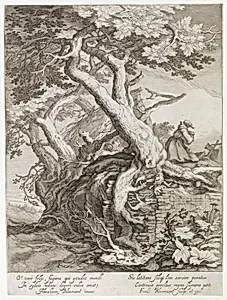
Landscape with a Hermit Praying
Medium
Engraving
Dimensions
sheet: 10 x 7 1/2 in. (25.4 x 19.1 cm)
Classification
Prints
Department
Drawings and Prints
Museum
Metropolitan Museum of Art, New York, NY
Credit
The Elisha Whittelsey Collection, The Elisha Whittelsey Fund, 1949
Accession Number
49.95.2772
Rights
Public Domain
Art Historical Context
In the tranquil *Landscape with a Hermiting*, attributed to Dutch masters Abraham Bloemaert and his son Frederick Bloemaert a solitary figure kneels in devotion amid a vast, evocative natural setting. Abraham (1566–1651), a leading figure of the Utrecht school during the Dutch Golden Age, was renowned for his versatile landscapes blending Mannerist elegance with emerging Baroque naturalism. Frederick, a skilled engraver, likely reproduced his father's design, capturing the scene's serene spirituality. Created around the early 17th century (date not specified), this print reflects the era's fascination with hermit saints, symbolizing piety and withdrawal from worldly distractions. As an engraving on a modest sheet measuring 10 x 7½ inches, the work exemplifies the precision of intaglio printmaking, where intricate lines etched into a copper plate allowed for detailed tonal effects and widespread dissemination. Prints like this were affordable alternatives to paintings, bringing Bloemaert's idyllic visions of nature infused with religious contemplation to collectors across Europe. The technique's fine lines evoke a sense of depth, drawing viewers into the hermit's quiet communion with the divine. Housed in the Metropolitan Museum of Art's Drawings and Prints department through The Elisha Whittelsey Collection (1949), this piece highlights the Bloemaerts' collaborative legacy in elevating landscape prints as both artistic and devotional objects, inviting modern visitors to pause and reflect on faith amid beauty.