
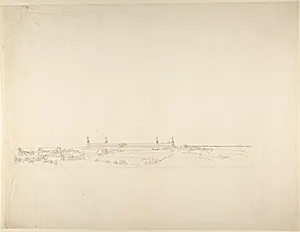
Landscape with a Large Building
Medium
Graphite, squared
Dimensions
14 7/8 x 19 1/2 in. (37.8 x 49.6 cm)
Classification
Drawings
Department
Drawings and Prints
Museum
Metropolitan Museum of Art, New York, NY
Credit
Harris Brisbane Dick Fund, 1953
Accession Number
53.600.3637
Rights
Public Domain
Tags
Art Historical Context
**Landscape with a Large Building** Franz von Hauslab the (1818–1883) is a meticulous graphite drawing from the 19th century, capturing a sweeping vista dominated by an imposing structure amid lush trees and distant houses. Created during the Biedermeier period in Austria—a time when precise, detailed renderings of everyday landscapes reflected a growing interest in national identity and topography—this work exemplifies Hauslab's skill as an amateur artist and cartographer's heir. The squared grid overlaid on the 14⅞ × 19½-inch sheet reveals its practical purpose: a preparatory study likely intended for enlargement, engraving, or mapping, a technique rooted in Renaissance traditions but perfected in the era of scientific illustration. Hauslab, son of a renowned Austrian military topographer, brought a disciplined eye to his landscapes, blending architectural precision with natural elements like fluttering flags that hint at civic pride or a festive scene. Rendered in graphite for its subtle tonal range, the drawing showcases fine line work that builds depth and atmosphere, inviting viewers to imagine the building's grandeur—perhaps a Viennese palace or fortress evoking Habsburg stability. Housed in the Metropolitan Museum of Art's Drawings and Prints department since 1953, thanks to the Harris Brisbane Dick Fund, this piece offers a window into 19th-century Europe's blend of art and documentation, reminding us how sketches like these bridged personal observation and cultural record-keeping. (218 words)