
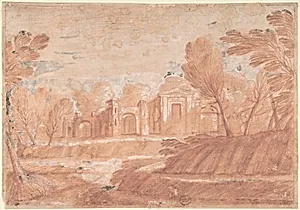
Landscape with Architectural Structure
Medium
Red chalk highlighted with white gouache on light brown paper; reworked counterproof
Dimensions
7-5/8 x 10-15/16 in. (19.4 x 27.8 cm)
Classification
Drawings
Department
Drawings and Prints
Museum
Metropolitan Museum of Art, New York, NY
Credit
Gift of Cornelius Vanderbilt, 1880
Accession Number
80.3.104
Rights
Public Domain
Tags
Art Historical Context
This enchanting *Landscape with Architectural Structure*, created by an anonymous Italian artist from the Roman-Bnese school in the th century, captures the blend of natural and built environments so prized in Baroque-era Italy. Rendered on light brown paper, the drawing depicts a serene vista of trees, rolling landscapes, and a prominent architectural form—likely a ruin or classical edifice—evoking the Roman countryside that inspired generations of artists. The Bolognese influence, rooted in the Carracci family's legacy, emphasized naturalistic observation and classical harmony, bridging the High Renaissance and emerging Baroque styles. The artwork's medium—red chalk heightened with white gouache—demonstrates masterful tonal control and luminosity, with the chalk's warm hues suggesting earthy depths and the gouache adding sparkling highlights to foliage and stone. Notably, it is a reworked counterproof: an impression taken from an original drawing (creating a reversed image), then refined by the artist. This technique, common among 17th-century draftsmen, reveals the iterative creative process, turning a proof into a finished study prized for its spontaneity and detail. Acquired as a gift from Cornelius Vanderbilt in 1880, this 7-5/8 x 10-15/16-inch gem resides in the Metropolitan Museum of Art's Drawings and Prints department. It offers visitors a window into Italy's golden age of landscape draftsmanship, where architecture and nature dialogued eternally.