
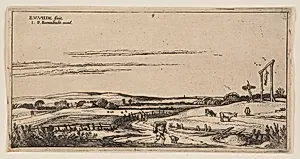
Landscape with Gallows (near Haarlem), from Landscapes
c. 1610-1630
Medium
Etching on ivory laid paper
Dimensions
Plate: 9.1 × 17.4 cm (3 5/8 × 6 7/8 in.)
Classification
etching
Department
Prints and Drawings
Museum
Art Institute of Chicago
Accession Number
268149
Rights
Public Domain
Art Historical Context
Esaias van de Velde (c. 1587–1630), a pioneering Dutch printmaker and painter of the early Golden Age, created *Landscape with Gallows (near Haarlem)* around 1610–1630 as part of his *Landscapes* series. intimate etching on ivory laid paper (plate: 9.1 × 17.4 cm) captures a serene yet evocative rural scene near Haarlem, de Velde's adopted hometown, blending natural beauty with a stark reminder of mortality: the gallows silhouetted against a vast sky. Van de Velde revolutionized landscape etching with his innovative use of line and tone, achieving subtle atmospheric effects like misty horizons and dappled light—techniques that influenced later masters such as Rembrandt. Executed during the Dutch Revolt's aftermath, when prosperity fueled interest in everyday vistas, the work reflects the era's fascination with topography and moral symbolism. Gallows, or gibbets, were common roadside fixtures displaying executed criminals, serving as public warnings of justice in the emerging Republic. Housed in the Art Institute of Chicago's Prints and Drawings department, this piece exemplifies how small-scale etchings democratized fine art, allowing broader access to van de Velde's masterful depictions of the Dutch countryside's quiet drama.