
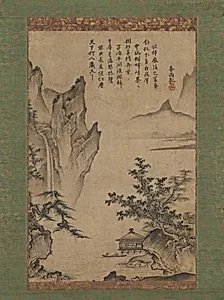
山水図|Landscape with Pavilion
Medium
Hanging scroll; ink and color on paper
Dimensions
Image: 19 13/16 x 13 13/16 in. (50.3 x 35.1 cm) Entire scroll: 58 5/8 x 19 in. (148.9 x 48.3 cm) Width including rollers: 21 in. (53.3 cm)
Classification
Paintings
Culture & Period
Japan · Muromachi period (1392–1573)
Department
Asian Art
Museum
Metropolitan Museum of Art, New York, NY
Credit
Purchase, Bequest of Stephen Whitney Phoenix, by exchange, 1985
Accession Number
1985.7
Rights
Public Domain
Tags
Art Historical Context
This exquisite hanging scroll, *Landscape with Pavilion* (山水図), was created around 1478–80 by the monk-painters Tōgen Zuisen and Kenkō Shōkei during Japan's Muromachi period (2–1573).ed in ink and light colors on paper, it measures about 20 by 14 inches in its image area, designed to be partially unrolled for intimate viewing. Hanging scrolls like this were prized in Zen temples and elite residences, evoking meditative tranquility through seasonal display. The painting captures the Muromachi era's fascination with Chinese-inspired shan shui (mountains-and-waters) landscapes, adapted with Japanese subtlety. Towering mist-shrouded peaks frame a modest pavilion, symbolizing scholarly retreat amid nature's grandeur—a Zen ideal of impermanence and harmony. Kenkō Shōkei, part of a lineage blending ink monochrome with delicate color washes, employs fluid brushwork for atmospheric depth: bold ink for rugged cliffs, soft dilutions for ethereal fog, creating a sense of boundless space on a compact surface. As a Metropolitan Museum of Art treasure from the Asian Art collection, it exemplifies Muromachi painting's cultural pinnacle under Ashikaga patronage, bridging Song dynasty models with native wabi-sabi aesthetics. Visitors are invited to imagine unrolling it in a tokonoma alcove, where mountains whisper timeless wisdom.
About the Artist
Tōgen Zuisen 桃源瑞仙|Kenkō Shōkei 賢江祥啓 (Japanese|Japanese) · 1430 |1478 –1480 |1523
Japanese, 1430–1480|Japanese, active ca. 1478–ca. 1523