
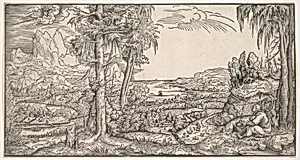
Landscape with Saint John the Evangelist
mid-16th century
Medium
Woodcut
Dimensions
sheet 7-3/4 x 14-5/8 in. (19.6 x 37 cm)
Classification
Prints
Department
Drawings and Prints
Museum
Metropolitan Museum of Art, New York, NY
Credit
Rogers Fund, 1920
Accession Number
20.24.77
Rights
Public Domain
Tags
Art Historical Context
In the mid-16th century, artist Virgil Solis crafted *Landscape with Saint John the Evangel*, a striking woodcut that captures the serene beauty of rolling hills, lush trees, and a contemplative religious figure. Measuring 7-3/4 x 14-5/8 inches, this print from the Metropolitan Museum of Art Drawings and Prints department exemplifies Renaissance fascination with nature as a divine backdrop. Saint John, often depicted as the visionary author of the Book of Revelation, stands amid the expansive vista, inviting viewers to ponder the harmony between humanity, spirituality, and the natural world. Solis, a prolific Nuremberg printmaker active from around 1540 to 1562, mastered the woodcut technique—a relief printing method where intricate designs were carved into wooden blocks, inked, and pressed onto paper. This affordable medium revolutionized art dissemination during the Reformation era, allowing biblical scenes like this to reach a wide audience beyond elite patrons. Solis's precise lines and tonal contrasts evoke depth and atmosphere, blending Northern Renaissance detail with emerging landscape traditions. Acquired through the Rogers Fund in 1920, this work highlights woodcuts' cultural role in 16th-century Europe, where religious imagery intertwined with the era's growing appreciation for topography. It's a window into how everyday viewers encountered sacred stories through accessible, evocative prints.