
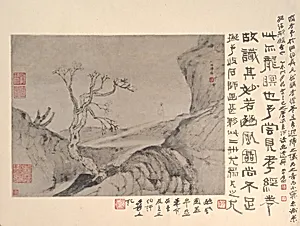
清 石濤 (朱若極) 山水人物圖 冊頁|Landscape with solitary figure
1660s
Medium
Album leaf; ink on paper
Dimensions
8 1/2 x 11 1/4 in. (21.6 x 28.6 cm)
Classification
Paintings
Culture & Period
China · Qing dynasty (1644–1911)
Department
Asian Art
Museum
Metropolitan Museum of Art, New York, NY
Credit
Bequest of John M. Crawford Jr., 1988
Accession Number
1989.363.151
Rights
Public Domain
Tags
Art Historical Context
Created in the 1660s during the early Qing dynasty, this intimate album leaf by Shitao (also known as Zhu Ruoji) captures a solitary figure within a sparse mountain landscape. Executed in ink on paper, the work exemplifies the traditional Chinese format of the album leaf—a portable, personal format meant for quiet contemplation rather than grand display. Shitao, a descendant of the Ming imperial family who became a Buddhist monk after the dynasty’s fall, infused his paintings with a sense of introspection and freedom from rigid academic rules. The composition’s modest scale (roughly 8½ by 11¼ inches) invites close viewing, allowing the viewer to appreciate the artist’s fluid brushwork and economical use of ink washes. The lone figure, dwarfed by towering rocks and open space, reflects a long-standing Chinese artistic theme: the harmony between humanity and nature, often tinged with quiet melancholy or spiritual seeking. Such images resonated deeply in the turbulent years following the Ming collapse, when many scholars and artists withdrew into reclusive or monastic life. Today housed in the Metropolitan Museum of Art, this leaf offers a window into Shitao’s innovative spirit and the enduring cultural importance of landscape painting as a vehicle for personal expression in Chinese art.