
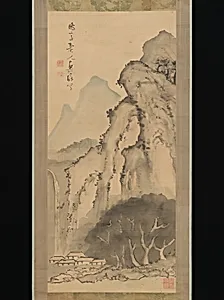
Landscape with Waterfall
ca. 1817
Medium
Hanging scroll; ink and color on silk
Dimensions
Image: 41 7/8 × 19 1/8 in. (106.4 × 48.6 cm) Overall with mounting: 71 5/8 × 23 3/4 in. (182 × 60.4 cm) Overall with knobs: 71 5/8 × 26 in. (182 × 66 cm)
Classification
Paintings
Culture & Period
Japan · Edo period (1615–1868)
Department
Asian Art
Museum
Metropolitan Museum of Art, New York, NY
Credit
Mary Griggs Burke Collection, Gift of the Mary and Jackson Burke Foundation, 2015
Accession Number
2015.300.191
Rights
Public Domain
Tags
About this artwork
This hanging scroll; ink and color on silk, created in ca. 1817, represents significant artistic achievement by Kameda Bōsai, a Japanese artist. The piece demonstrates the technical capabilities and aesthetic conventions of Japanese art during this historical period. Working in hanging scroll; ink and color on silk, the artist employed materials and techniques characteristic of the era, creating visual effects that convey both subject matter and artistic vision. Museum collections preserve such ...
Art Historical Context
Kameda Bōsai's *Landscape with Waterfall*ca. 1817) is a captivating hanging scroll Japan's Edo period (1615–1868), a time of cultural flourishing under the Tokugawa shogunate artists explored nature's grandeur through refined literati styles. This ink and color on silk painting captures misty mountains and a cascading waterfall, evoking the sublime power of the natural world—a common theme in Japanese landscapes that invited contemplation and harmony with the environment. The hanging scroll format, with its luxurious silk surface (41 7/8 × 19 1/8 in.), was ideal for intimate display in homes or temples, unrolled for seasonal appreciation. Bōsai masterfully layered ink washes for depth and subtle colors for atmospheric effects, showcasing Edo-era techniques that blended Chinese-inspired literati painting (nanga) with indigenous sensibilities. Now in the Metropolitan Museum of Art's Mary Griggs Burke Collection, this work highlights the era's aesthetic priorities: simplicity, fluidity, and emotional resonance. Preserved through meticulous conservation, it offers visitors a window into Japan's artistic legacy, reminding us how such scrolls bridged personal meditation and cultural storytelling across centuries.
About the Artist
Kameda Bōsai (Japanese) · 1752 –1826
Japanese, 1752–1826