
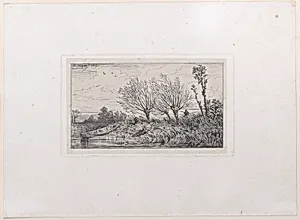
Landscape with Willow Trees
1845
Medium
Etching
Dimensions
Sheet: 7 3/8 × 10 1/8 in. (18.8 × 25.8 cm) Plate: 3 9/16 × 5 7/8 in. (9 × 15 cm)
Classification
Prints
Department
Drawings and Prints
Museum
Metropolitan Museum of Art, New York, NY
Credit
Gift of Howard Mansfield, 1931
Accession Number
31.20.28
Rights
Public Domain
Art Historical Context
**Landscape with Willow Trees** (1845) by Charles Jacque captures the serene beauty of the French countryside through delicate etching. Jacque, a prominent French artist and member of the Barbizon School, was renowned for his pastoral scenes featuring rustic landscapes and farm animals. This intimate print, measuring just 3 9/16 × 5 7/8 inches on the plate, invites viewers into a tranquil glade dominated by gracefully drooping willow trees, evoking the natural harmony celebrated by 19th-century Realists. Etching, Jacque's chosen medium, allowed for intricate line work and tonal depth, as acid etched fine details into a metal plate for multiple impressions. Created during the Barbizon movement's heyday—a reaction against academic art's stiffness—this work reflects the school's emphasis on direct observation of nature, foreshadowing Impressionism. The modest scale made such prints accessible to collectors, blending artistry with reproducibility. Today, housed in the Metropolitan Museum of Art's Drawings and Prints department as a 1931 gift from collector Howard Mansfield, *Landscape with Willow Trees* offers a window into mid-19th-century rural France. Its subtle textures and atmospheric mood remind us of art's power to preserve fleeting natural moments. (198 words)
About the Artist
Charles Jacque · 1813–1894
Charles-Émile Jacque (1813–1894) was a pioneering French painter, engraver, and illustrator whose career bridged the worlds of printmaking and pastoral painting. Born in Paris amid a difficult childhood, he apprenticed at age seventeen to a map engraver, mastering drypoint technique and producing his first etching in 1830—a copy of a head after Rembrandt. After serving seven years in the French Ar...