
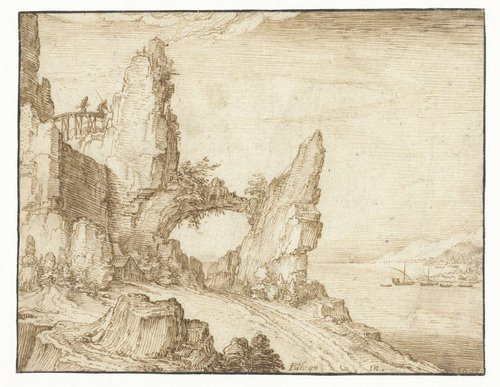
Landschap met steile rotsen bij een rivier
Medium
pen
Dimensions
103; 133
Rights
Public Domain
About this artwork
Dit landschap heeft iets gemeenschappelijks qua techniek met de landschappen van Pieter Brueghel, zoals het Landschap met de Rotsen van de Saitn Baume, te Londen, gedateerd 1600. Het motief, de groepering van rotsen met een doorgang bij een rivier wordt ook aangetroffen bij de schilderijen en tekeningen van Matthijs Cock, bijvoorbeeld, op de achtergrond van het portret van deze kunstenaar geëtst door J. Hondius.
Art Historical Context
Jacques de Gheyn II’s delicate 1603 pen drawing, *Landschap met steile rotsen bij een rivier*, captures a dramatic riverside landscape dominated by towering rock formations and a narrow passage. Measuring just 103 by millimeters, the compact sheet invites close viewing, revealing the artist’s precise linework that defines craggy surfaces and the gentle flow of water below. Created in the early years of the Dutch Golden Age, the drawing reflects the growing interest in naturalistic yet imaginative landscape subjects among Northern European artists. The work shares notable technical affinities with Pieter Bruegel the Elder’s landscapes, particularly his 1600 drawing *Landschap met de Rotsen van Saint-Baume* now in London. De Gheyn employs a similar economy of stroke to suggest depth and texture. The central motif of steep rocks framing a river passage also echoes compositions by Matthijs Cock, appearing, for instance, in the backgrounds of portraits engraved by J. Hondius. These connections highlight how early seventeenth-century Dutch draftsmen absorbed and reinterpreted Flemish landscape traditions. Through its restrained yet evocative pen technique, the drawing demonstrates how artists of the period transformed observed nature into compelling visual poetry, offering museum visitors a window into the evolving language of landscape art.