
Lappet (one of a pair)
Unknown Artist
early 18th century
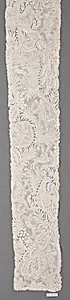
Medium
Bobbin lace, point d'Angleterre
Dimensions
L. 24 x W. 4 1/4 inches (61.0 x 10.8 cm)
Classification
Textiles-Laces
Culture
Flemish, Brussels
Department
European Sculpture and Decorative Arts
Museum
Metropolitan Museum of Art, New York, NY
Credit
The Mabel Metcalf Fahnestock Collection, the gift of Ruth Fahnestock Schermerhorn and Faith Fahnestock, 1933
Accession Number
33.90.91
Rights
Public Domain
Tags
Art Historical Context
This exquisite lappet, one of a matching pair from early 18th-century Brussels, exemplifies the pinnacle of Flemish lacemaking artistry. Crafted as a narrow, decorative band—measuring 24 by 4¼ inches—it was likely designed for women's fashion, such as adorning the edges of bonnets, dresses, or shawls. Produced in the renowned lace-making center of Brussels, it the opulence of the era, when intricate textiles served as symbols of wealth and refinement among Europe's elite. The medium, bobbin lace in the point d'Angleterre style, highlights masterful technical virtuosity. Bobbin lace involves twisting and plaiting fine linen threads on pillows pinned with patterns, creating dense, sculptural motifs—here, delicate flowers that bloom with lifelike precision. Point d'Angleterre, a Brussels specialty imitating English needlepoint lace, features bold outlines and shaded effects, showcasing the lacemaker's skill in achieving transparency and depth without a visible ground fabric. Such pieces demanded months of labor from highly skilled artisans. Housed in The Metropolitan Museum of Art's European Sculpture and Decorative Arts Department, this lappet from The Mabel Metcalf Fahnestock Collection (gifted in 1933) offers a glimpse into the cultural prestige of lace. In an age before machine production, these floral treasures embodied Flemish innovation and the global trade in luxury goods, adorning nobility from Versailles to colonial drawing rooms.