
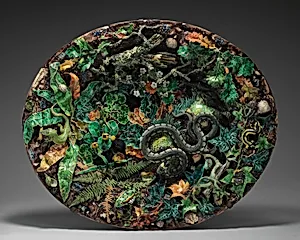
Large basin with snake, ferns, and bark
ca. 1850–1855
Medium
Glazed earthenware
Dimensions
confirmed, irregular oval: 3 3/4 × 25 5/8 × 21 in. (9.5 × 65.1 × 53.3 cm)
Classification
Ceramics-Pottery
Culture
French
Department
European Sculpture and Decorative Arts
Museum
Metropolitan Museum of Art, New York, NY
Credit
Gift of Wallis Katz, in memory of Marshall Katz, and in celebration of the Museum's 150th anniversary, 2020
Accession Number
2020.86.15
Rights
Public Domain
Art Historical Context
Charles-Jean Avisseau’s Large basin with snake, ferns, and bark, created around 1850–1855, is a striking example of mid-nineteenth-century French ceramics. Made of glazed earthenware and measuring roughly twenty-six inches across, the irregular oval form was designed as both a functional vessel and a sculptural centerpiece. Its shallow depth and broad surface allowed the artist to treat the interior like a miniature landscape. The basin’s surface is animated by carefully modeled natural elements—a coiled snake, delicate ferns, and textured bark—that demonstrate Avisseau’s command of relief modeling and glazing techniques. These motifs reflect the period’s growing fascination with the natural sciences and the Romantic interest in the untamed outdoors, transforming everyday pottery into an object of contemplation. Now part of the Metropolitan Museum of Art’s European Sculpture and Decorative Arts collection, the piece was generously given in celebration of the museum’s 150th anniversary. It invites viewers to appreciate how French potters of the era elevated humble materials into richly detailed works that celebrate both craftsmanship and the beauty of the natural world.