
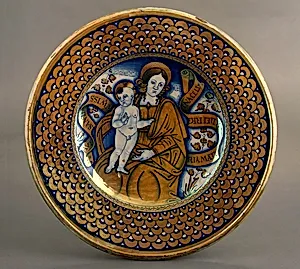
Large dish with scale border; in the center, the Madonna and Child
c. 1500/1535
Medium
tin-glazed earthenware (maiolica)
Dimensions
overall (diameter): 45.5 cm (17 15/16 in.)
Classification
Decorative Art
Department
CSD
Museum
National Gallery of Art, Washington, D.C.
Credit
Widener Collection
Accession Number
1942.9.325
Rights
Public Domain
Art Historical Context
This stunning large dish from Deruta, Italy, dating to around 1500–1535, exemplifies the Renaissance mastery of maiolica—a tin-glazed earthenware prized its brilliant colors and glossy finish. Measuring nearly 18 inches in diameter, the piece features a distinctive scale-patterned border framing a central depiction of the Madonna and Child a beloved motif in Christian art symbolizing maternal tenderness and divine love. Produced in Deruta's renowned workshops in Umbria, such dishes were not just functional serving ware but also status symbols for affluent households, blending everyday utility with devotional artistry. The tin-glazing technique was revolutionary: artisans painted vivid designs on unfired earthenware coated with tin oxide, then fired it to create an impermeable, jewel-like surface that held intricate details without fading. Deruta's 16th-century output, like this example from the Widener Collection at the National Gallery of Art, reflects the era's fusion of Islamic ceramic influences with Italian humanism, making religious scenes accessible in domestic settings. Its survival highlights maiolica's enduring appeal, bridging fine art and craft during a time when Italy led Europe's ceramic innovation.