
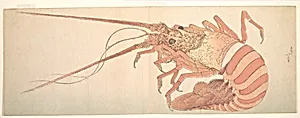
Large Lobster
1800–1815
Medium
Woodblock print (surimono); ink and color on paper
Dimensions
7 5/16 x 19 7/8 in. (18.6 x 50.5 cm)
Classification
Prints
Culture & Period
Japan · Edo period (1615–1868)
Department
Asian Art
Museum
Metropolitan Museum of Art, New York, NY
Credit
H. O. Havemeyer Collection, Bequest of Mrs. H. O. Havemeyer, 1929
Accession Number
JP1865
Rights
Public Domain
Tags
Art Historical Context
Behold the *Large Lobster*, a captivating woodblock print (surono) by the legendary Katsushika Hokusai, created between 1800 and 1815 during Japan's Edo period (1615–1868). This intimate horizontal composition, measuring just 7 5/16 x 19 7/8 inches, exemplifies Hokusai's early mastery in ukiyo-e—the "pictures of the floating world" tradition that celebrated everyday beauty and nature. Surimono, privately commissioned for special occasions like New Year's greetings were luxurious prints often featuring poetry and intricate embellishments, making this piece a treasured personal artifact rather than mass-produced art. Hokusai, renowned for later masterpieces like *The Great Wave off Kanagawa*, here vividly captures the lobster's segmented form with bold lines, vibrant inks, and subtle color gradients on paper—a testament to the woodblock technique where carvers and printers collaborated meticulously. In Japanese culture, lobsters (ebi) symbolize longevity and vitality, evoking bent elders who remain youthful at heart, adding layers of auspicious meaning perfect for celebratory prints. Part of the Metropolitan Museum of Art's H. O. Havemeyer Collection, this work invites us to marvel at Hokusai's ability to elevate the humble crustacean into a symbol of enduring elegance, bridging art, nature, and tradition.
About the Artist
Katsushika Hokusai · 1760–1849
Katsushika Hokusai (1760-1849) stands as one of history's most influential artists, a Japanese master who revolutionized the ukiyo-e woodblock print tradition and profoundly shaped Western art. Born in the Katsushika district of Edo (modern-day Tokyo) to an artisan family, Hokusai lived through nearly nine decades of extraordinary creative evolution, adopting over thirty different artistic names t...