
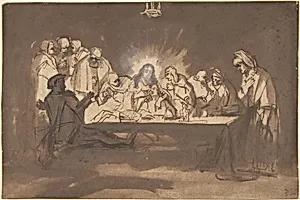
Last Supper
late 1650s
Medium
Pen and brown ink, brush and brown wash, over traces of red chalk, heightened with white gouache, with framing line in pen and brown ink. Laid down.
Dimensions
7 11/16 x 11 1/2 in. (19.5 x 29.2 cm)
Classification
Drawings
Department
Drawings and Prints
Museum
Metropolitan Museum of Art, New York, NY
Credit
Frits and Rita Markus Fund, 2001
Accession Number
2001.500
Rights
Public Domain
Tags
Art Historical Context
Philips Koninck's *Last Supper*, created in the late 1650s, offers a captivating glimpse into the Dutch Golden Age's mastery of draftsmanship. Though Koninck is best known for his expansive landscapes inspired by Rembrandt—his uncle by marriage—this intricate drawing depicts the biblical scene of Christ and his disciples at their final meal. Rendered on a modest sheet measuring 7 11/16 x 11 1/2 inches, it exemplifies the period's reverence for preparatory studies and autonomous works on paper, prized by collectors for their spontaneity and skill. The medium—pen and brown ink with brush and brown wash over faint red chalk underdrawing, heightened with white gouache—creates dramatic chiaroscuro effects, modeling figures with subtle tonal gradations and luminous highlights. This monochromatic technique, common in Rembrandt's circle, allowed artists like Koninck to explore composition and light dynamically before committing to paint, blending precision with expressive freedom. The framing line adds a polished finish, suggesting it was intended as a finished piece. Housed in the Metropolitan Museum of Art's Drawings and Prints department, acquired through the Frits and Rita Markus Fund in 2001, this work highlights the cultural centrality of religious narratives in 17th-century Dutch art, even amid the era's secular landscapes. It invites visitors to appreciate how such intimate drawings bridged studio practice and spiritual devotion.