
lavender
late 19th–early 20th century
Medium
glasswares
Classification
glasswares
Department
Smithsonian Collection
Museum
Smithsonian American Art Museum
Credit
Gift of the Estate of Max Kobre
Accession Number
1996-45-14
Rights
Public Domain
About this artwork
Research in Progress
Art Historical Context
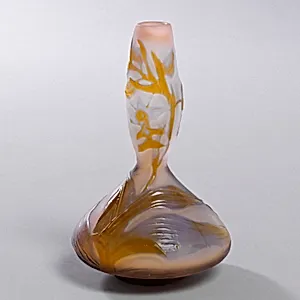
Émile Gallé, a pioneering French glassmaker of the late 19th and early 20th centuries created *Lavender* during the height of the Art Nouveau movement Associated with the École de, Gallé revolutionized decorative arts by drawing inspiration from nature, often embedding floral motifs like lavender into his intricate glass designs. This piece, housed in the Smithsonian American Art's collection, exemplifies his mastery of glasswares—elegant vases, lamps, and objets d'art that blurred the line between craft and fine art. Gallé's techniques, such as cameo cutting, marquetry, and acid-etched layering, allowed him to achieve luminous depth and subtle color gradations, evoking the delicate hues of blooming lavender. These methods not only showcased technical innovation but also carried Symbolist undertones, celebrating nature's beauty amid the Industrial Revolution's mechanization. *Lavender* reflects this era's push for organic forms and individuality in design. A generous gift from the Estate of Max Kobre, this work invites visitors to appreciate Gallé's enduring influence on modern glass art. Though research continues, its presence in the Smithsonian underscores the global reach of French Art Nouveau in American collections.
About the Artist
Gallé (French| ) · 1846 | –1904 |
French, Nancy 1846–1904 Nancy|