
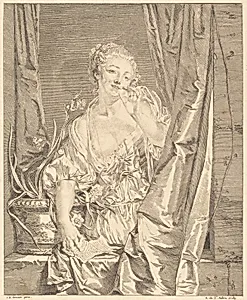
Le baiser envoyé
Medium
etching and engraving
Classification
Department
CG-E
Museum
National Gallery of Art, Washington, D.C.
Credit
Widener Collection
Accession Number
1942.9.2354
Rights
Public Domain
Art Historical Context
**Le baiser envoyé (The Sent Kiss)**, an exquisite 1771 etching and engraving by Augustin de Saint-Aubin Jean-Baptiste Greuze, a tender moment of youthful affection. Greuze, a leading French painter of the late Rococo and early Neoclassical periods, was renowned for his sentimental genre that evoked moral lessons through everyday emotions. Here, Saint-Aubin masterfully reproduces Greuze's composition, likely depicting a young girl blowing a kiss, innocence with subtle drama—a hallmark of Greuze's style that charmed 18th-century audiences amid the Enlightenment's focus on human sentiment. The medium of etching and engraving was revolutionary for its time, allowing intricate details like soft textures and expressive faces to be precisely translated from painting to print. Etching used acid to bite lines into a metal plate for fluid effects, while engraving added sharp, controlled incisions, making this work a prime example of reproductive printmaking. These techniques democratized art, enabling wider distribution of Greuze's popular imagery to collectors and the emerging middle class across Europe. Housed in the National Gallery of Art's Widener Collection (Department CG-E), this print highlights the era's fascination with emotional storytelling in visual art. It invites visitors to appreciate how 18th-century printmakers like Saint-Aubin preserved and popularized Greuze's evocative narratives, bridging fine art with everyday appreciation.