
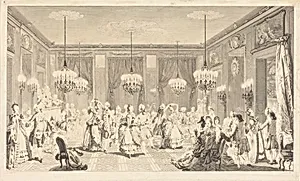
Le bal pare
Medium
etching
Classification
Department
CG-E
Museum
National Gallery of Art, Washington, D.C.
Credit
Widener Collection
Accession Number
1942.9.2457
Rights
Public Domain
Art Historical Context
**Le Bal Paré (The Masquerade Ball)** ched in 1774 by Antoine Duclos after a design by Augustin de Saintubin, *Le Bal Paré* captures elegance of 18th-century French high society. This intricate print depicts a lively masquerade ball, where revelers in elaborate costumes and masks whirl through a candlelit hall, evoking the opulent world of the Ancien Régime just before the French Revolution.clos, a skilled reproductive engraver, faithfully translated Saint-Aubin's Rococo drawing into etching—a technique prized for its fine lines and tonal depth, allowing detailed textures like flowing silks and flickering lights. Rococo art, with its playful ornamentation and focus on leisure, flourished in Louis XV and XVI's courts, and prints like this one popularized such scenes among a broader audience. Etchings were affordable and reproducible, spreading fashionable imagery from aristocratic salons to urban collectors. Saint-Aubin, part of a renowned family of illustrators, excelled in vignettes of daily life and fêtes, making this work a window into pre-Revolutionary frivolity. Housed in the National Gallery of Art's Widener Collection (Department CG-E), *Le Bal Paré* exemplifies the gallery's strength in European prints, inviting visitors to ponder the fleeting gaiety that masked deeper social tensions of the era.