
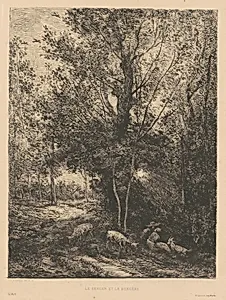
Le Berger et La Bergre
Medium
etching and drypoint
Classification
Department
CG-E
Museum
National Gallery of Art, Washington, D.C.
Credit
Corcoran Collection (Bequest of Frank B. Bristow)
Accession Number
2015.143.131
Rights
Public Domain
Art Historical Context
**Le Berger et La Bergère (The Shepherd and The Shepherdess)**, created by Charles-François Daub in 1874, the serene beauty of rural life through the delicate medium of etching and drypoint This intimate print from the National Gallery Art's Corcoran (Bequest of Frank. Bristow) a shepherd and shepherdess amid pastoral landscapes, evoking the timeless harmony between humans and nature that defined Daubigny's oeuvre. Daubigny, a leading figure in the Barbizon School, pioneered plein-air painting and influenced Impressionists like Monet and Pissarro with his loose, atmospheric brushwork. By 1874, late in his career, he masterfully adapted these qualities to printmaking. Etching provided precise lines etched into a copper plate with acid, while drypoint added velvety burrs from direct needle engraving, yielding rich textures and subtle tones that mimic the softness of his oil landscapes. This work exemplifies 19th-century French printmaking's evolution toward expressive realism, blending technical innovation with romantic nostalgia for the countryside. Visitors will appreciate its poetic charm, a window into Daubigny's enduring legacy at the cusp of modernism. (198 words)
About the Artist
Charles-François Daubigny · 1817–1878
Charles-François Daubigny was born on February 15, 1817, in Paris into a family of artists, with his father, Edmé-François Daubigny, a classical landscape painter, and his uncle, Pierre Daubigny, a miniaturist, providing his initial artistic training. He further studied under Jean-Victor Bertin, Jacques Raymond Brascassat, and Paul Delaroche at the École des Beaux-Arts, though he quickly moved bey...