
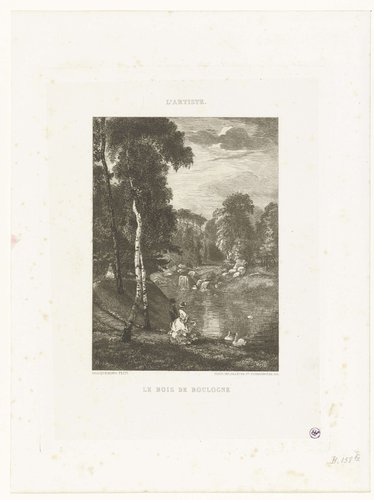
Le Bois de Boulogne
Medium
etching
Dimensions
244; 184
Rights
Public Domain
About this artwork
ets op chine collé
Art Historical Context
Félix Bracquemond *Le Bois de Boulog* (1857) invites visitors into the lush allure of Paris's iconic park during the Second Empire era. This intimate etching, measuring just 244 × 184 mm, captures wooded paths and leisurely ambiance of the Bois de Boune—a fashionable retreat for Parisians amid Haussmann's urban transformations. Bracquem, a leading French printmaker (18331914), was a in reviving etching as a fine art, bridging Realism and the emerging Impressionist sensibilities through his precise yet atmospheric lines. Crafted as an etching ("ets") on *chine collé*—a technique where delicate, thin Chinese paper is glued to a stronger support—the work showcases Bracquemond's technical virtuosity. This method allowed for subtle tonal variations and fine details, enhancing the print's velvety texture and luminosity, ideal for evoking dappled sunlight filtering through trees. Etchings like this were prized collectibles, making high art accessible beyond paintings. Bracquemond's piece reflects mid-19th-century Paris's blend of nature and modernity, influencing later printmakers. A gem for etching enthusiasts, it reminds us how a small plate can transport us to a vibrant epoch.
About the Artist
Félix Bracquemond · 1833–1914
French, Paris 1833–1914 Sèvres