
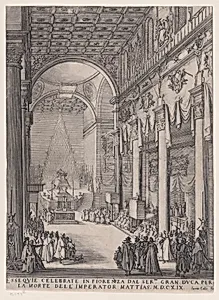
Le Catafalque de l'Empereur Mathais pièce appelée aussi Le Petit Prédicateur, La Chapelle Funèbre de Florence et Requiem de L'Empereur Mathais (The Catafalque of the Emperor Matthais, piece also called The Small Preacher, The Funerary Chapel of Florence, The Requiem of the Emperor Matthais)
1619
Medium
Etching and engraving; second state of three (Lieure)
Dimensions
Sheet: 11 x 8 in. (27.9 x 20.3 cm)
Classification
Prints
Department
Drawings and Prints
Museum
Metropolitan Museum of Art, New York, NY
Credit
Harris Brisbane Dick Fund, 1917
Accession Number
17.3.3236
Rights
Public Domain
Art Historical Context
In this etching and engraving, Jacques Callot presents a sweeping view down the nave of a grand Florentine chapel. Tall columns and an ornate coffered ceiling frame the space, while heavy drapery and heraldic shields hang from the walls. At the center stands a towering, tiered catafalque glowing with countless candles; clusters of mourners in long cloaks and wide-brimmed hats gather along both sides, some kneeling in prayer while others converse quietly. Callot created the print in 1619 to record the elaborate funeral rites held in Florence for Holy Roman Emperor Matthias. Working in the precise technique of etching and engraving, he captured both the architectural splendor and the solemn human activity of the occasion. The resulting image preserves a vivid eyewitness account of early-seventeenth-century court ceremony and the artist’s remarkable ability to convey scale, light, and atmosphere within a single sheet.
About the Artist
Jacques Callot · 1592–1635
Jacques Callot (1592–1635) was a French printmaker and draftsman from the Duchy of Lorraine, widely regarded as one of the first great artists to practice the graphic arts exclusively. His more than 1,400 etchings chronicled the breadth of 17th-century life, from Medici court festivities to the brutal realities of warfare. Callot revolutionized etching through technical innovations including the é...