
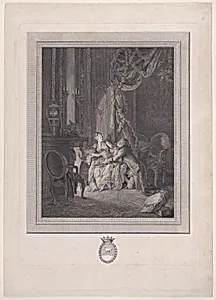
Le danger du tête-à-tête
Medium
Etching and engraving
Dimensions
Image: 11 13/16 × 9 5/8 in. (30 × 24.5 cm) Plate: 14 3/16 × 10 7/16 in. (36 × 26.5 cm) Sheet: 16 15/16 × 12 5/8 in. (43 × 32 cm)
Classification
Prints
Department
Drawings and Prints
Museum
Metropolitan Museum of Art, New York, NY
Credit
Bequest of Susan Dwight Bliss, 1966
Accession Number
67.630.115
Rights
Public Domain
Tags
Art Historical Context
**Le danger du tête-à-t (The Danger of the T-à-Tête)** This intriguing 18th-century print created by French artists Pierre Antoine Baudouin and-Baptiste-Blaise Simonet, captures the tension of a private encounter between men and women. The title, translating to "The Danger of the T-à-Tête," hints at a moralistic warning about the risks of intimate conversations, a common theme in Rococo-era art that blended playful sensuality with social commentary. Baudouin, known for his delicate genre scenes, likely designed the composition, while Simonet contributed to the precise engraving, resulting in an image measuring about 12 by 9.5 inches. Etching and engraving techniques were ideal for the period, allowing intricate details—like expressive faces and suggestive gestures—to be reproduced affordably for a wide audience. These prints circulated moral tales amid the libertine culture of pre-Revolutionary France, reminding viewers of propriety's fragile boundaries. Housed in the Metropolitan Museum of Art's Drawings and Prints department (Bequest of Susan Dwight Bliss, 1966), it exemplifies how 18th-century printmaking democratized art, sparking conversations on human folly and desire. (198 words)
About the Artist
Pierre Antoine Baudouin|Jean-Baptiste-Blaise Simonet · 1723–1769
Comment on works: Genre; History; Allegory