
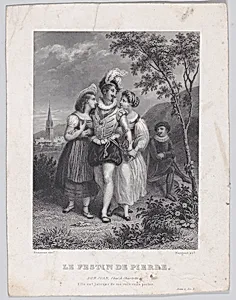
Le Festin de Pierre
Medium
Etching and engraving
Dimensions
Image: 4 7/16 × 3 1/4 in. (11.2 × 8.2 cm) Sheet: 5 15/16 × 4 1/2 in. (15.1 × 11.4 cm)
Classification
Prints
Department
Drawings and Prints
Museum
Metropolitan Museum of Art, New York, NY
Credit
Harris Brisbane Dick Fund, 1933
Accession Number
33.104.2449
Rights
Public Domain
Art Historical Context
**Le Festin de Pierre created between 1824 and 1826 by French artists Jean-Denis Nargeot Alexandre Joseph Desenne, a dramatic moment from the legendary tale of *Don Juan*. The title, translating to "The Stone Feast," evokes the climactic supper scene from Molière's 1665 play *Dom Juan, Le Festin de pierre*, where the libertine nobleman dines with the stone statue of a man he has wronged—a story later immortalized in Mozart's opera *Don Giovanni*. This intimate print reflects the Romantic era's fascination with moral tales, supernatural retribution, and human folly, popular in French theater and visual arts during the early 19th century. Rendered in etching and engraving on a modest scale (image 4 7/16 × 3 1/4 in.), the work showcases the precision of these printmaking techniques. Etching allows for fluid, expressive lines, while engraving adds sharp detail and tonal depth, making it ideal for reproducing intricate scenes from literature or stage. Such collaborative prints were vital for disseminating cultural narratives to a wider audience beyond elite theatergoers, bridging high art with popular entertainment. Housed in The Metropolitan Museum of Art's Drawings and Prints department, acquired via the Harris Brisbane Dick Fund in 1933, this piece highlights the technical mastery of French illustrators like Desenne, known for his vignettes in books and periodicals. It invites visitors to ponder timeless themes of hubris and fate through a window into 19th-century print culture.