
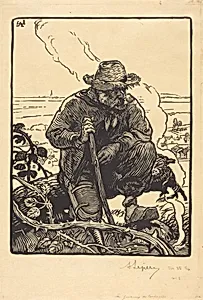
Le gueux des campagnes
1895
Medium
woodcut on Japan paper
Classification
Department
CG-E
Museum
National Gallery of Art, Washington, D.C.
Credit
Gift of Joan Lees in memory of Edward Lees, M.D.
Accession Number
1981.58.1
Rights
Public Domain
Art Historical Context
Auguste Lepère's *Le gueux des campagnes (The Countryside Beggar), created in 1895, the poignant essence of rural French life during the fin-de-siècle era. As a master French engraver and illustrator, Lepère specialized in woodcuts that romanticized the countryside, often portraying humble figures like peasants and wanderers against evocative landscapes. This print likely depicts a solitary beggar traversing the fields, embodying the hardships and resilience of rural existence amid France's shift toward industrialization. Rendered as a woodcut on delicate Japan paper—a thin, luxurious sheet imported from Asia that enhances the print's texture and ink absorption—Lepère's technique showcases his virtuosity in relief printing. Woodcuts, revived by 19th-century artists as a fine art medium, allowed for bold lines and rich tonal contrasts, influenced by Japonisme. Lepère's intricate carving produces atmospheric depth, where light filters through foliage and shadows define the figure's weary form. Housed in the National Gallery of Art's Prints department (gift of Joan Lees in memory of Edward Lees, M.D.), this work highlights Lepère's contribution to elevating everyday scenes into poetic vignettes. It invites visitors to reflect on the cultural nostalgia for vanishing rural traditions in modernizing Europe.
About the Artist
Auguste Lepère · 1849–1918
Auguste-Louis Lepère (1849–1918), son of the sculptor François Lepère, was born in Paris on November 30, 1849, into an artistic family that shaped his early path. At age thirteen, he apprenticed in the Paris studio of the English wood engraver Joseph Burn Smeeton, honing his skills in wood engraving until 1867. He furthered his training with drawing classes under Horace Lecoq de Boisbaudran at the...