
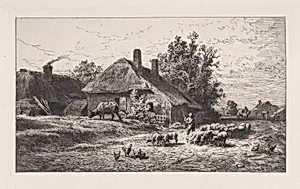
Le Hameau
1867
Medium
Etching
Dimensions
Plate: 7 1/16 × 9 13/16 in. (18 × 25 cm) Image: 5 1/8 in. × 9 in. (13 × 22.8 cm)
Classification
Prints
Department
Drawings and Prints
Museum
Metropolitan Museum of Art, New York, NY
Credit
Harris Brisbane Dick Fund, 1927
Accession Number
27.10.68
Rights
Public Domain
Art Historical Context
Charles Jacque’s 1867 etching *Le Hameau* captures the quiet charm of a rural hamlet, rendered with the delicate precision that etching allows. Created during a period when printmaking was experiencing renewed interest among French artists, the work demonstrates Jacque’s mastery of line and texture. The medium’s ability to produce fine, expressive marks made it ideal for evoking the subtle play of light and shadow across village rooftops and surrounding fields. Measuring just over five by nine inches in the image area, this intimate print invites close viewing. Etchings like this one were often produced in editions, allowing wider audiences to experience scenes of everyday rural life that might otherwise remain accessible only through paintings. The plate marks and tonal variations visible in the impression highlight the technical skill involved in controlling acid bite and ink application. Acquired by the Metropolitan Museum of Art through the Harris Brisbane Dick Fund in 1927, *Le Hameau* preserves a moment of 19th-century French countryside imagery. It offers today’s visitors a window into both the artistic techniques of the era and the enduring appeal of pastoral subjects in graphic art.
About the Artist
Charles Jacque · 1813–1894
Charles-Émile Jacque (1813–1894) was a pioneering French painter, engraver, and illustrator whose career bridged the worlds of printmaking and pastoral painting. Born in Paris amid a difficult childhood, he apprenticed at age seventeen to a map engraver, mastering drypoint technique and producing his first etching in 1830—a copy of a head after Rembrandt. After serving seven years in the French Ar...