
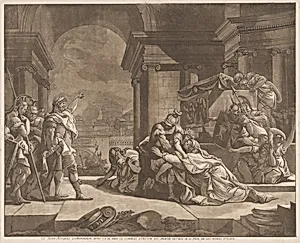
Le Jeune Astianax qu’Andromaque avoit caché dans le tombeau d’Hector est arraché des bras de sa Mere par les ordres d'Ulisse (Young Astianax, who Andromache Hid in Hector's Tomb, is Seized from his Mother's Arms by Ulysses' Orders)
Medium
etching and aquatint on laid paper
Dimensions
sheet (trimmed to plate): 53.9 × 66 cm (21 1/4 × 26 in.)
Classification
Department
CG-E
Museum
National Gallery of Art, Washington, D.C.
Credit
Pepita Milmore Memorial Fund
Accession Number
2018.91.26
Rights
Public Domain
Art Historical Context
This dramatic print captures a pivotal moment from Greek mythology, as recounted in ancient sources like Euripides’ *The Trojan Women*. Young Astyanax, the son of the fallen Trojan hero Hector, had been hidden by his mother Andromache inside Hector’s tomb to protect him from the victorious Greeks. Here, the boy is forcibly seized from her arms on the orders of Ulysses (Odysseus), who fears the child could grow up to avenge Troy. The composition conveys intense emotion through Andromache’s desperate grasp and the soldiers’ determined advance, reflecting the 18th-century fascination with classical narratives of heroism, sacrifice, and fate. Created in 1766 by François-Philippe Charpentier after a painting by Gabriel François Doyen, the work exemplifies the period’s Neoclassical turn toward antique subjects rendered with heightened drama and moral weight. Charpentier employed etching combined with the relatively new aquatint technique, which allowed him to achieve rich tonal gradations and painterly effects on the copper plate. Printed on laid paper and measuring over half a meter wide, the large sheet was designed to disseminate Doyen’s history painting to a broader audience, functioning both as an independent work of art and as a reproductive print that brought grand academic compositions into private collections.