
Le Lac
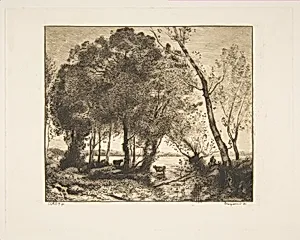
Medium
Etching; first state of two
Dimensions
Sheet: 8 in. × 11 7/16 in. (20.3 × 29 cm) Plate: 6 1/8 × 7 7/8 in. (15.6 × 20 cm)
Classification
Prints
Department
Drawings and Prints
Museum
Metropolitan Museum of Art, New York, NY
Credit
Gift of David Keppel, 1922
Accession Number
22.1.25
Rights
Public Domain
Tags
Art Historical Context
**Le Lac (The Lake), 1861** Nestled in the serene tradition of 19th-century French landscape, *Le Lac* captures a tranquil pastoral scene featuring a glassy lake flanked by trees and grazing cows. Created collaboratively by painter Camille Corot, a master of the Barbizon school for his poetic realism and luminous atmospheres, and etcher Félix Bracquem, a leading figure in French printmaking, this work reflects the era's fascination with nature's quiet beauty. Corot's soft, atmospheric drawing—likely the basis for Bracquemond's etching—evokes the harmonious rural idylls that influenced later Impressionists. As a first-state etching, this rare proof (one of only two states) showcases the meticulous intaglio process: acid biting into a metal plate to create fine, expressive lines that convey depth, texture, and subtle tonal gradations. Measuring just 6⅛ × 7⅞ inches on the plate, its intimate scale invites close contemplation, highlighting etching's power to democratize fine art through affordable prints. Produced in 1861 amid France's Second Empire, it embodies the Romantic reverence for unspoiled countryside amid rapid industrialization. Today, housed in the Metropolitan Museum of Art's Drawings and Prints department (gift of David Keppel, 1922), *Le Lac* stands as a testament to artistic collaboration and the enduring allure of etched landscapes, bridging painting's vision with print's precision.
About the Artist
Félix Bracquemond|Camille Corot · 1833–1914
French, Paris 1833–1914 Sèvres