
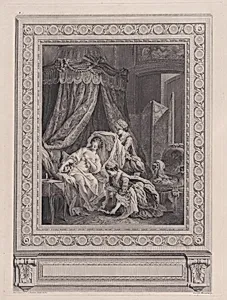
Le Lever
Medium
Engraving
Dimensions
Image: 15 1/8 × 10 9/16 in. (38.4 × 26.9 cm) Plate: 15 9/16 × 11 5/8 in. (39.5 × 29.5 cm) Sheet: 19 3/16 × 13 3/8 in. (48.7 × 34 cm)
Classification
Prints
Department
Drawings and Prints
Museum
Metropolitan Museum of Art, New York, NY
Credit
Harris Brisbane Dick Fund, 1954
Accession Number
54.533.14
Rights
Public Domain
Art Historical Context
"Le Lever," an exquisite engraving from 1771, showcases the collaborative talents of French Rococo painter Pierre Antoine Baudouin and engraver Jean Massard Baudouin, known for his delicate, intimate scenes of daily life infused with sensuality, provided the original design, which Massard meticulously translated into print. This reproductive engraving allowed the elegance of Baudouin's work to reach a wider audience beyond elite collectors, exemplifying the era's booming print culture. Created during the twilight of the Rococo period, just before the rise of Neoclassicism, "Le Lever" (meaning "The Rising" or "Getting Up") likely depicts a graceful morning ritual, capturing the refined luxury of 18th-century French domesticity. Engravings like this one, with their precise lines and tonal depth achieved through Massard's burin technique, were prized for their fidelity to the painter's touch while enabling mass production. The generous sheet size—nearly 19 by 13 inches—highlights its status as a collector's piece. Housed in the Metropolitan Museum of Art's Drawings and Prints department, acquired via the Harris Brisbane Dick Fund in 1954, this work reflects the cultural fascination with private moments elevated to art. It invites visitors to appreciate how prints democratized high art, bridging the opulent world of Versailles with everyday admiration.
About the Artist
Pierre Antoine Baudouin|Jean Massard · 1723–1769
Comment on works: Genre; History; Allegory