
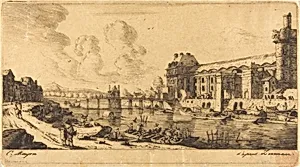
Le Pavillion de Mlle. et une partie du Louvre
Medium
etching on laid paper
Dimensions
plate: 13.9 x 25 cm (5 1/2 x 9 13/16 in.) sheet: 14.2 x 25.1 cm (5 9/16 x 9 7/8 in.)
Classification
Department
CG-E
Museum
National Gallery of Art, Washington, D.C.
Credit
Gift of Gaillard F. Ravenel and Frances P. Smyth-Ravenel
Accession Number
2000.7.30
Rights
Public Domain
Art Historical Context
Step back to the grandeur of 17th-century with *Le Pavillion de M. et une partie du* (1849), a delicate etching by artist Charles Meryon, after an original by Dutch master Reinier Nooms, known as Zeeman. Nooms, a celebrated etcher of the Dutch Golden Age, captured the city's bustling waterfronts and architecture during his visits to Paris in the 165s and 1660s. Meryon, renowned for precise, atmospheric views of Paris, revived this scene nearly two centuries later, preserving a vanishing urban landscape amid Haussmann's modern transformations. The image focuses on the elegant Pavillon de la Mademoiselle—a private residence linked to Louis XIV's court—and a segment of the sprawling Louvre complex, rendered with intricate line work on laid paper (plate: 13.9 x 25 cm). Etching allowed Meryon to achieve fine textures and depth, evoking the Baroque splendor of royal architecture against the Seine. This print exemplifies 19th-century Romantic interest in historical revival, blending Nooms' lively urban detail with Meryon's technical virtuosity. A generous gift to the National Gallery of Art from Gaillard F. Ravenel and Frances P. Smyth-Ravenel, it invites visitors to ponder Paris's layered history through the intimate scale of printmaking. (198 words)