
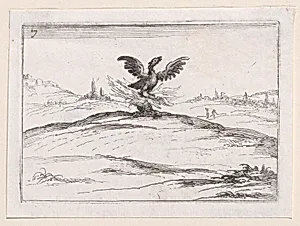
Le Phénix se Brulant (The Phoenix is Burning), from Lux Claustri ou La Lumière du Cloitre (The Light of the Cloisters), plate 7
Medium
Etching; second state of two (Lieure)
Dimensions
Sheet: 2 11/16 x 3 5/8 in. (6.8 x 9.2 cm) Plate: 2 5/16 x 3 3/8 in. (5.8 x 8.5 cm)
Classification
Prints
Department
Drawings and Prints
Museum
Metropolitan Museum of Art, New York, NY
Credit
Bequest of Edwin De T. Bechtel, 1957
Accession Number
57.650.349(6)
Rights
Public Domain
Tags
About this artwork
This diminutive etching by Jacques Callot forms part of "Lux Claustri ou La Lumière du Cloitre" (The Light of the Cloisters), a series of emblematic prints exploring spiritual themes through allegorical imagery. Created between 1621 and 1635 and published by François Langlois, "Le Phénix se Brulant" (The Phoenix is Burning) depicts the legendary bird consumed in transformative fire, a powerful symbol of resurrection and eternal renewal central to Christian iconography. Callot, working in Nancy a...
Art Historical Context
Welcome to the Metropolitan Museum of Art's Drawings and Prints collection, where Jacques Callot's exquisite etching *Le Phénix se Brulant* (The Phoenix Burning), plate 7 the series *Lux Claustri ou La Lumière Cloitre* (The of the Cloisters),ivates with its spiritual depth. Created between 1621 and1635 and published by François Langlois, this diminutive work—measuring just over three inches—depicts the mythical phoenix consumed in flames, a timeless emblem of resurrection and eternal renewal deeply rooted in Christian iconography. During the Counter-Reformation, when Catholic artists and thinkers sought to reaffirm faith through vivid symbols, Callot's image resonated powerfully, evoking spiritual death and rebirth. Part of an emblematic series blending allegory with moral lessons, it made profound theological ideas accessible and memorable for 17th-century viewers in Nancy and Paris. Callot, a master innovator in printmaking, achieved astonishing detail, tonal variation, and precision using pure line work in this second-state etching. His technical brilliance at such a tiny scale revolutionized the medium, turning small prints into intricate windows on the divine. A true gem from the bequest of Edwin De T. Bechtel in 1957, it invites us to ponder renewal amid life's trials.