
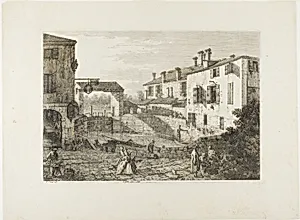
Le Porte Del Dolo, from Vedute
1735/44
Medium
Etching in black on ivory laid paper
Dimensions
Image: 29.9 × 42.9 cm (11 13/16 × 16 15/16 in.); Plate: 30.2 × 43.4 cm (11 15/16 × 17 1/8 in.); Sheet: 43.1 × 58.6 cm (17 × 23 1/8 in.)
Classification
etching
Department
Prints and Drawings
Museum
Art Institute of Chicago
Accession Number
159756
Rights
Public Domain
Art Historical Context
Canaletto’s *Le Porte del Dolo*, created between 1735 and 1744, belongs to his celebrated *Vedute* series of etched views. The Venetian master, renowned for his luminous depictions of architecture and light, translated his painted scenes into print to reach a broader audience across Europe. This etching captures the quiet drama of the locks at Dolo along the Brenta River, where elegant villas and working waterways meet. Executed in black etching on ivory laid paper, the work showcases Canaletto’s precise line work and subtle tonal gradations. The medium allowed him to render intricate details—from rippling water to distant bell towers—with remarkable clarity while maintaining the atmospheric quality of his paintings. Measuring just under 12 by 17 inches in the plate, the print balances intimate observation with expansive landscape. Today housed in the Art Institute of Chicago’s Prints and Drawings department, this impression highlights the 18th-century fascination with travel and topography. Canaletto’s *Vedute* helped shape how viewers imagined the Italian countryside, turning everyday scenes into enduring images of place and time.
About the Artist
Canaletto · 1697–1768
The most famous view-painter of the 18th century, Canaletto's works are characteristically topographically correct with smooth, precise handling. His patrons were primarily English collectors.