
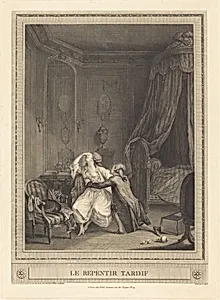
Le repentir tardif
1726 to 1750
Medium
etching
Classification
Department
CG-E
Museum
National Gallery of Art, Washington, D.C.
Credit
Widener Collection
Accession Number
1942.9.2418
Rights
Public Domain
Art Historical Context
This etching, titled *Le repentir tardif (“The Late Repentance”), created by the French printmaker Gérard Le Vilain after a design by Nicolas Lavreince. Produced in the mid-eighteenth century, it belongs to a flourishing tradition of reproductive prints that translated paintings and drawings into widely affordable images for collectors and the growing middle-class audience. Etching, in which an artist draws through a wax ground on a metal plate before acid bites the lines, offered exceptional delicacy and atmospheric nuance. Le Vilain used the medium to capture the intimate, anecdotal character typical of Lavreince’s work—elegant interiors and human dramas that mixed gallantry with a hint of moral reflection. Such scenes were immensely popular in France during the rococo era, when art often explored the pleasures and pitfalls of fashionable life. Now in the National Gallery of Art’s Widener Collection, the print reminds us how etchings served as both artistic interpretations and vehicles of cultural exchange, bringing refined narrative imagery into homes far beyond the original painter’s studio.