
Le Songe d'un habitant du Mogol
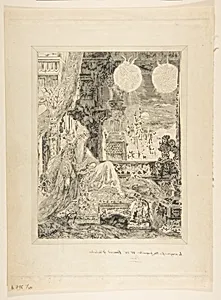
Medium
Etching; first state of seven
Dimensions
Sheet: 15 3/8 × 11 1/4 in. (39.1 × 28.6 cm) Plate: 14 1/16 × 10 7/8 in. (35.7 × 27.7 cm)
Classification
Prints
Department
Drawings and Prints
Museum
Metropolitan Museum of Art, New York, NY
Credit
The Elisha Whittelsey Collection, The Elisha Whittelsey Fund, 1963
Accession Number
63.625.16(2)
Rights
Public Domain
Tags
Art Historical Context
**Le Songe d'un habitant du Mogol (The Dream of a Mughal Inhabitant), 1886** This captivating etching, the first state of seven, showcases a collaboration between master printmaker Félix Bracquemond and Symbolist painter Gustave Moreau, published by the luxury firm Boussod, Valadon & Co. Likely inspired by Jean de La Fontaine's fanciful tales, the title evokes an exotic dreamscape from Mughal India, blending French 19th-century artistry with Orientalist imagination. Measuring about 15 by 11 inches, its intricate plate captures architecture and male figures in a visionary haze, characteristic of Moreau's mystical style and Bracquemond's precise etching technique. Etching in its earliest state offers a rare glimpse into the printmaking process—before later refinements added depth or details—making it a collector's prize for its freshness and technical purity. Produced amid France's fin-de-siècle fascination with the East, the work reflects broader cultural exchanges, where European artists romanticized distant empires through lush, dream-like compositions. Housed in the Metropolitan Museum of Art's Drawings and Prints department (The Elisha Whittelsey Collection, 1963), this print invites visitors to ponder the interplay of reality and reverie, bridging La Fontaine's moral fables with Symbolist allure. A testament to collaborative innovation, it highlights etching's power to evoke otherworldly wonders.
About the Artist
Félix Bracquemond|Gustave Moreau|Jean de La Fontaine|Boussod, Valadon and Co. · 1833–1914
French, Paris 1833–1914 Sèvres