
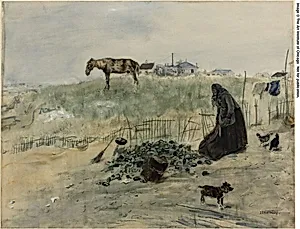
Le Terrain Vague
c. 1882
Medium
Watercolor and oil paint, with graphite and colored pencils, on cream wove paper
Dimensions
30.9 × 39.7 cm (12 3/16 × 15 11/16 in.)
Classification
watercolor
Department
Prints and Drawings
Museum
Art Institute of Chicago
Accession Number
84085
Rights
Public Domain
Art Historical Context
Jean-François Rafaëlli’s *Le Terrain Vague* (c. 1882) captures the quiet poetry of an urban wasteland, a subject that fascinated the French artist throughout his career. Working in the outskirts of Paris during a period of rapid industrialization, Rafaëlli often turned his attention to neglected lots, suburban fringes, and everyday scenes that other artists overlooked. The modest scale of this work—roughly 12 by 16 inches—invites close viewing, drawing attention to the subtle textures of overgrown earth and scattered debris. The piece is notable for its experimental mixed media: Rafaëlli combined watercolor and oil paint with graphite and colored pencils on cream wove paper. This layered approach allowed him to achieve both the luminous washes of watercolor and the precise, linear details of drawing, creating a rich surface that feels at once spontaneous and carefully observed. Such technical versatility reflects the broader artistic experimentation of the late nineteenth century, when many artists blurred the boundaries between painting and drawing. Today housed in the Prints and Drawings department of the Art Institute of Chicago, *Le Terrain Vague* offers a window into Rafaëlli’s realist sensibility and his interest in the changing landscape of modern France. The title, meaning “the vacant lot” or “wasteland,” underscores his fascination with transitional spaces that speak to both urban growth and quiet abandonment.